Northbound train pulling into Bletchley railway station
Showing posts with label rail fares. Show all posts

02 January 2011

Fair Fares Now


The transport charity Campaign for Better Transport has launched Fair Fares Now, a campaign for 2011 to persuade the Government to ensure that rail travel has:
  • Affordable prices, including peak times and turn-up-and-go tickets
  • Reliable services that aren’t overcrowded
  • Straightforward tickets that make train travel simple
Fair Fares Now is highlighting this week's increases and the Government's sanctioning of even greater increases from 2012.

If you share my view that commuters already get a raw deal in terms of cost and service then you will want to visit the Fair Fares Now campaign website to find out more about the campaign and how you can help spread the word.

See also on this blog:
  • 7.2% not justified (London Midland 2011 increases above national average for Milton Keynes, Bletchley & Leighton Buzzard)
  • Inflation +3%  (Government announces new formula for fare increases)
  • How much?!!  (Government subsidy paid to London Midland and salary packages of the top executives)

.

19 December 2010

7.2% not justified

London Midland made the 2011 ticket prices available last week. The average national increase imposed under an agreed formula was 5.8% (RPI + 1%). The price of my season ticket (annual, standard class, Bletchley-London terminals with no Travelcard) increases from £3,316 to £3,556. That's 7.2%.

The London Midland Twitter service (@londonmidland) has proved to be a far more effective way of communicating views and queries to the train operator, so on Tuesday I used the service to ask how an increase 1.4% above the standard had been justified.


After a few exchanges I got back the following explanation the same day (direct exchange, so not publicly available and undated):


After receiving this I still didn't get it, so London Midland offered an explanation by email. This has still to be received (the London Midland customer service people have a good excuse with Thursday's train driver strike looming), so I figured I'd try and work it out for myself. 

After an hour of looking at daily, weekly, monthly and annual fares, new and old, from various stations I'm still none the wiser.   London Midland appear to be saying that the reason for Bletchley (non-Travelcard) season tickets going up by 7.2% is to address an anomaly in the relative day/annual and Leighton Buzzard/Bletchley/Milton Keynes, yet what I found was that there have been even bigger increases in the equivalent cost of travelling from the other two stations which has made that anomaly even worse!
  • Leighton Buzzard season ticket without Travelcard: £3,292 in 2010.  £3,536 in 2011.  Increase 7.41%
  • Bletchley season ticket without Travelcard: £3,316 in 2010.  £3,556 in 2011.  Increase 7.22%
  • Milton Keynes season ticket without Travelcard: £3,832 in 2010. £4,140 in 2011.  Increase 8.04%
If I've got my figures wrong and/or London Midland provide an explanation as to why all three stations have had such a significant increase above the standard rate then I will post up a follow up message.

In the meantime I'll say:

London Midland appear to have imposed an arbitrary, above standard increase, taking advantage of passengers who have no choice but to use their service. 

It is very difficult to see how these increases can be justified given that there has, if anything, been a degradation in the service over the last 12 months.  

As a passenger I find I am paying more to travel on trains which are less frequent and which take longer to get to my destination.


(Interestingly, while doing some research for yesterday's posting about this week's ASLEF strike I found that the General Secretary of that union appears to also have strong views about this round of fare increases.  See Rail fare increases are madness says GS).

I'd love to know what you think so whether you agree or disagree, please express your own view via the comment box below.


.

28 November 2010

I don't get it...

I'm hoping that someone can explain what's going on with rail fares.

At a time when they are increasing taxes and reducing benefits, the Government has every reason to encourage (or even force) private companies to limit price increases.

Train operating companies (TOCs) receive income from two sources - the taxpayer (see How much!) and the rail traveller.   It doesn't look like there's any change on the former, but they are allowing major increases on the latter.  This year is covered by the old formula, RPI +1%, but future increases will be higher. 

Why?  There's talk of the rail fare increases being imposed now funding the future purchases of rolling stock, but the list of routes that are due to receive the new trains don't include London Midland.  Sorry, but I don't understand...

One final thought.  When it suits the Government they have been switching pricing formulae from being calculated against Retail Price Index (RPI) to being Consumer Price Index (CPI) based (e.g. with pensions).  This means lower increases.  For rail fares, despite the review of the formula, we remain RPI based.  Why?

Can anyone help make sense of this?  I know I can't.


See ATOC press release - Train companies confirm fare changes for 2011

.

21 October 2010

Inflation +3%

"The cap on regulated rail fares will rise to RPI +3% for the three years from 2012, but that will help this country afford new rolling stock as well and improve passenger conditions."

George Osborne
Chancellor of the Exchequer
Comprehensive Spending Review - 20 October 2010

____________________________________________

So what do we think? 

After many years of seeing the price of commuting into London rise in real terms are we happy at the prospect of paying even more in the future? 

Are we content to hear that the rail operating companies will be levying an increase that is unlikely to be exceeded by any salary increase that we receive?

Do we think we will get value for money?

Season ticket price 2010 = £3,316
Season ticket price 2015 = £4,780?

29 August 2010

Travel back to 1967


I've been loaned a copy of the ABC Rail Guide dated June 1967.  Probably not everyone's idea of a good read, but interesting nonetheless.

Before we get into the train services of the time, let's 'set the scene'...  In 1967 Britain had a Labour Government with Harold Wilson as Prime Minister.  The average salary that year was around £1,380 and inflation was 2.5%.  The average UK house price was £4,000 and a basic Auston Mini (the Mk2 version was launched in 1967) cost £509.

On 1 June the Beatles released Sgt. Pepper's Lonely Hearts Club Band and that month the no.1 slot in the charts alternated between Aretha Franklin's Respect and Groovin' by the Young Rascals.

The New Town designation order that resulted in the purchase of 22,000 acres of farmland for what was to become Milton Keynes was passed in January 1967, but that name was then still only associated with a village to the north of Bletchley.  

In June 1967 Bletchley railway station offered passenger services to Cambridge and Oxford as well as London and the north.  The 0714 from Bletchley would get a traveller to Cambridge for 0841. 

The station had been rebuilt in by 1964 with the steam shed that stood on what is now the site of the car park closing the following year, 1965.

So what was the service like to and from Euston in June 1967?   In some respects, not much different to today.   Looking at southbound trains for a fairly typical (now) 0700-0730 and 1740-1810 commute:

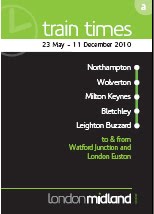
Northampton--0701
Wolverton--0715
Bletchley arr--0723
Bletchley dep070407150724
Leighton
Buzzard
071207230732
Cheddington0717--
Tring07230733-
Berkhamsted07280738-
Hemel
Hempstead
0733-0749
Apsley07360745
King's Langley07400749-
Watford
Junction arr
0745--
Watford
Junction dep
0746-0758
Harrow &
Wealdstone
0753-0805
Euston080808150822
Euston174217551805
Harrow &
Wealdstone
-1809-
Watford
Junction arr
1805-1825
Watford
Junction dep
1806-1826
King's Langley-1820-
Apsley1813--
Henel
Hempstead
181618251834
Berkhamsted18221830-
Tring18271836-
Cheddington-1841-
Leighton
Buzzard
1838-1852
Bletchley arr184618541900
Bletchley dep1847-1901
Wolverton1854-1908
Northampton1908-1922

The services are slower (each journey looks to be around ten minutes longer than the equivalent today), but every train calls at Bletchley so there was far more choice than there is today (there are seven trains each way between Bletchley and Euston 0700-0800 and 1700-1800).

In addition to the local services, Bletchley was also a stopping point for express trains coming down from and going up to the north.  There were no such southbound calls during the morning 'rush hour' but someone able to travel during the day could enjoy:
  • From Blackpool - Bletchley 1119 Euston 1200
  • From Barrow - Bletchley 1304 Euston 1343
  • From Carlisle - Bletchley 1319 Euston 1400
  • From Blackpool - Bletchley 1519 Euston 1600
There were similar trains southbound in the evening and the equivalent services northbound throughout the day.

The standard one-way fares for the journey were First Class 19/3 (£0.97) or Second Class 12/9 (£0.64).   The return fare would have been double the single.  

The biggest surprise of all in the timetable is the listing of an overnight sleeper services calling at Bletchley:
  • From Euston (2125) and Bletchley (2215) to Larbert (0540), Stirling (0550), Gleneagles (0622) and Perth (0640)
  • From Stranaer Harbour (2210) and Dumfries (0110) to Bletchley (0649) and Euston (0742)
  • From Liverpool Lime Street (0030) to Bletchley (0400) and Euston (0457)
For these services the supplement (on top of the normal fare) was First Class with single berth 45/- (£2.25) or Second Class with double berth 30/- (£1.50).

Finally, the ABC Rail Guide rather quaintly lists the following information for Bletchley:

- 46 3/4 miles from London
- Population 22,110
- Early closing Wednesdays
- Refreshment Room

(The refreshment room stood on what is now platforms 2-3 and was still in operation, serving alcoholic drinks as well as tea, sandwiches and cakes in the late 1980s).

For anyone like me who is interested in the local history of this area and/or the railway I can recommend one website and one book:
  • Where the lines meet (the Railway History of Bletchley)
  • Bletchley to Rugby: including Newport Pagnell & Northampton by Vic Mitchell and Keith Smith (available from Amazon)

07 August 2010

Summer sale

"Yay! I have booked my train tickets for London this weekend"

"Excellent! Will cost me just £2.95 return to Redditch on Sat with the @LondonMidland online rail sale!"

"My London Midland 1/2 price sale tckts have arrived £10.80 for the lad and I London returns with Family Railcard. Brilliant"

These are just some of the 'Tweets' that LondonMidland have been forwarding on in their recent postings on Twitter that promote their current half-price off-peak ticket offer (see London Midland - Summer Rail Sale).

So what do we commuters think?  Personally, I'm not sure how I view this. 

I do think it's great that people can travel for less and if they are on off-peak weekend or midweek morning and afternoon/evening trains then it doesn't impact on me.  London Midland get to earn some extra income from people who wouldn't otherwise travel, money which maybe will keep an extra member of staff on their books or fund some service improvements.

I have to admit that another part of me is a bit annoyed that London Midland are prepared to see people travel from Bletchley to Euston and back for £7 while they charge us a year in advance the equivalent of £14+ to do same journey just at a different time.  I guess this is just envy, one of the seven deadly sins...

What do you think?


30 June 2010

10% railfare increase?!!

The press has been full of stories this week about the comment from Philip Hammond, the new Government Transport Secretary, that there is no guarantee that the current inflation + 1% formula for railfare increases can be maintained.


Commuters are staring down the barrel of a 6% increase in 2011 anyway (5% inflation + 1%), and the prediction is that the Government may allow the train operating companies (including London Midland) to raise prices by up to 10%.  In the current climate of pay freezes and even salary cuts, that wouldrepresent a significant hit on commuters.


In a previous posting ("How much?!!") I mentioned that the cheque that the taxpayers have written out to London Midland to cover the 2010 subsidy is a whacking £185 million.  According to this week's press articles, the total subsidy paid to the rail industry is £5.21 billion.  That bill needs to be cut, but why should this be to the cost of the rail passengers?


London Midland seem to come out on top whatever happens.  If I've read the situation properly then there are two possible scenarious:
  1. They keep the full subsidy for 2011 (the amount paid reduces year on year but for it's apparently £175 million); or
  2. The subsidy is reduced but they then get permission to make up the difference by increasing our fares.
Is it an exaggeration to say that the arrangements between central Government and the train operating companies are scandalous?   London Midland et al are in a "heads I win, tails you lose" situation.  Private enterprise is meant to be about risk.  take the risk and you potentially get the reward.  These guys get the reward without any risk...  

Anyone interested in reading more on this subject may like to look at the following press articles